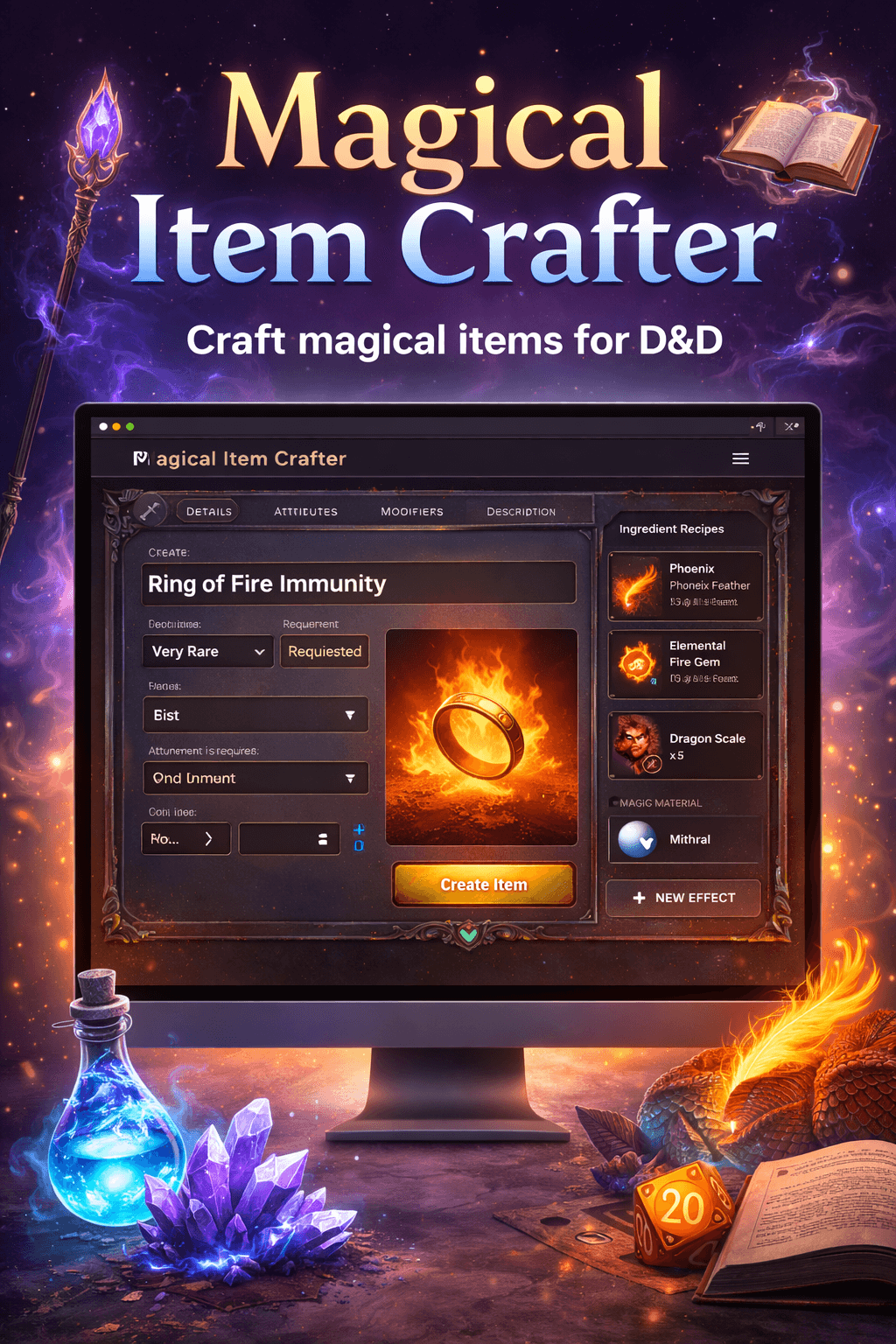
The current magic system lives in a sprawling Excel workbook: items organized by category (plants, gems, monsters, anatomy, etc.), each with attributes, schools, and numeric values. Looking anything up mid-session meant digging through tabs and rows. Crafting a new magical item meant juggling cost formulas, quality multipliers, and context modifiers by hand.
Data Explorer — Browse, filter, and sort the full item catalog. Search by name, filter by category or school, paginate through results. Full CRUD so the dataset stays current without touching the spreadsheet.
Crafting Wizard — A five-step guided flow for building magic items:
- Pick your magic attribute, school, and base cost
- Search and add crafting components from the item database
- Adjust quality multipliers
- Apply location, event, and holiday cost modifiers
- Review the final calculation and save the session
Sessions persist, so you can save mid-craft and pick up later.
AI Query — Ask natural language questions about the dataset, powered by Amazon Bedrock.
- Frontend: Next.js (static export) with TanStack Query, deployed to S3 + CloudFront
- Backend: Serverless Framework on AWS Lambda with Drizzle ORM against PostgreSQL (Neon)
- Infrastructure: AWS CDK for S3, CloudFront; Serverless Framework for API Gateway + Lambda
- Data Pipeline: Excel workbook import via a Lambda-powered ETL endpoint
The entire thing runs serverless — no servers to manage, scales to zero when idle, and costs practically nothing for a small group of users.
PostgreSQL over DynamoDB — The item data is inherently relational (items belong to categories and schools, crafting sessions reference multiple items with join-like lookups). Postgres with Drizzle ORM made queries straightforward.
Static export over SSR — The data changes infrequently and there's no user-specific content on the public pages. A static Next.js export behind CloudFront keeps latency low and hosting simple.
Excel as the source of truth — Rather than rebuilding the entire dataset from scratch, the import pipeline reads directly from the existing workbook. This kept the game master's workflow intact — edit the spreadsheet, re-import, done.
Serverless is a great fit for niche tools like this. The usage pattern is bursty (game nights), the dataset is modest, and the team is small. The pay-per-request model means it costs almost nothing between sessions, and there's zero ops overhead.
The crafting wizard was the most fun to build — turning a manual formula-heavy process into a step-by-step UI with live cost calculations made the game experience noticeably smoother.
Built with Next.js, AWS Lambda, PostgreSQL, and AWS CDK.